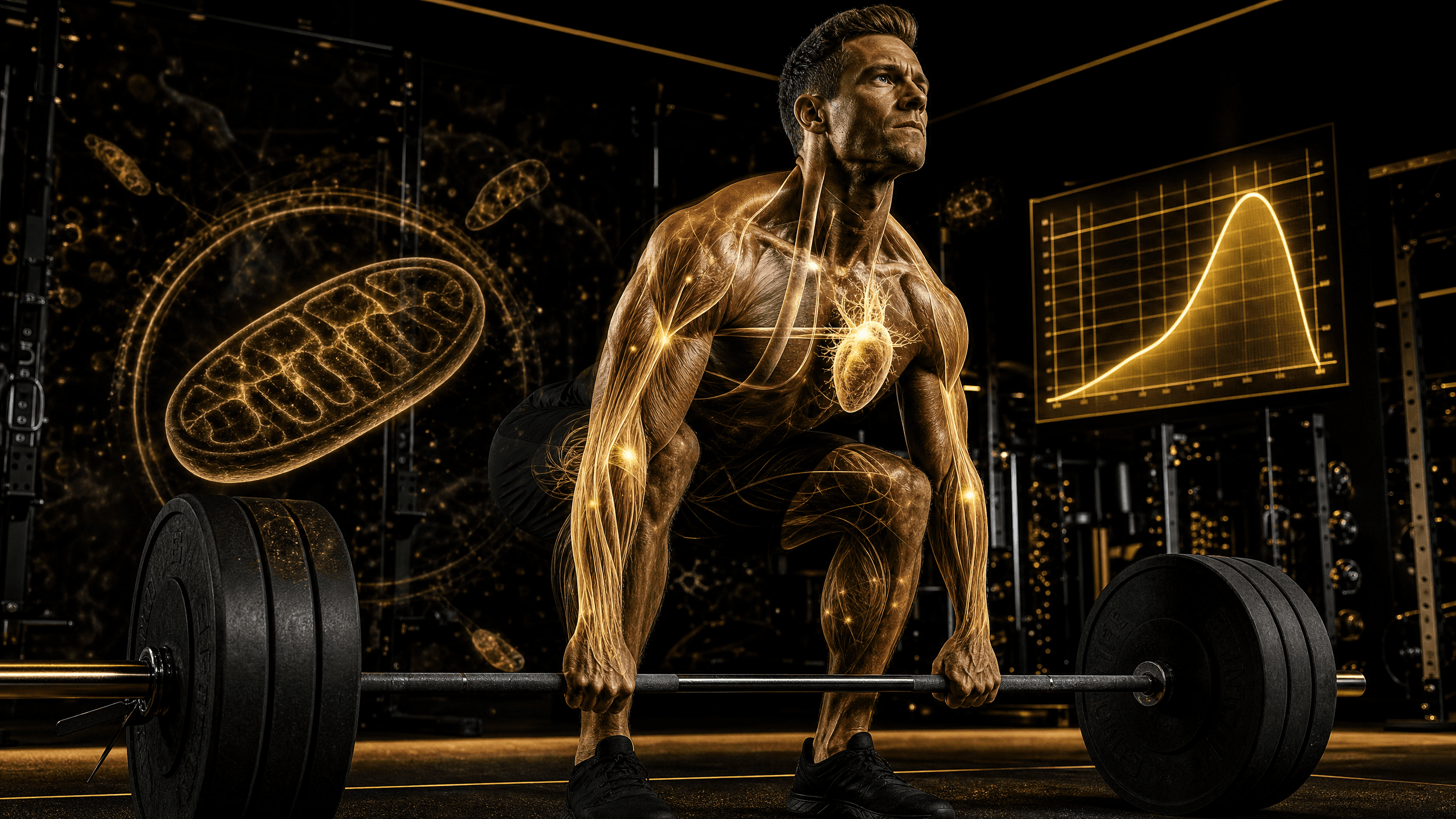
Why Muscle Is Your Most Important Longevity Organ
The fitness industry has spent decades framing muscle as an aesthetic goal. Longevity science has reframed it as a survival imperative. Skeletal muscle is not merely the tissue that moves your limbs — it is the body's largest metabolic organ, responsible for disposing of the majority of dietary glucose, producing myokines (hormone-like signalling molecules that communicate with every other organ system), and serving as the primary reservoir of amino acids available for immune function, wound healing, and protein synthesis during illness.
Sarcopenia — the progressive loss of muscle mass and function with age — begins in the mid-30s and accelerates after 50, proceeding at roughly 1–2% per year without intervention. Its consequences are not merely physical. Sarcopenia is independently associated with insulin resistance, metabolic syndrome, cognitive decline, immune dysfunction, and dramatically increased all-cause mortality. The research is unambiguous: the more muscle mass you maintain into later life, the longer and healthier you live.
Grip strength — a simple proxy for overall muscle strength — is one of the most powerful predictors of longevity in the epidemiological literature. In the PURE study of over 140,000 people across 17 countries, grip strength was a stronger predictor of cardiovascular mortality than systolic blood pressure. This is not because grip strength itself is protective — it is because it reflects the overall state of your musculoskeletal system.
Continue this pillar
Build the standards behind Movement & Muscle
Take the next step with SEVYN University courses matched to this pillar, then complete the assessment so your pathway can be prioritised around your data, goals, and current capacity.
Use recovery data to guide when to push, pull back, and adapt.
Connect movement, muscle, recovery, nutrition, and longevity into one system.
Protocols
- ◆Zone 2 cardio: 150 minutes per week (walking, cycling, swimming at conversational pace)
- ◆Resistance training: 2x per week, full body, compound movements
- ◆Daily step count: 8,000–10,000 steps minimum
- ◆Mobility routine: 10 minutes daily (hip flexors, thoracic spine, shoulders)
- ◆Grip strength training: farmer's carries, dead hangs
- ◆Avoid prolonged sitting: movement break every 45–60 minutes
- ◆Zone 2 cardio: increase to 180+ minutes per week
- ◆Resistance training: 3–4x per week, progressive overload tracking
- ◆VO2 max intervals: 4x4 Norwegian protocol (4 minutes at 90–95% max HR, 4 minutes rest, 4 rounds) 1–2x per week
- ◆DEXA scan for body composition baseline (muscle mass, bone density, visceral fat)
- ◆Creatine monohydrate 5g daily (enhances strength and muscle protein synthesis)
- ◆HRV-guided training: reduce intensity when HRV is suppressed
- ◆VO2 max testing (metabolic cart) for precise training zone calibration
- ◆BPC-157 peptide for injury recovery and connective tissue repair
- ◆TB-500 (Thymosin Beta-4) for muscle repair and regeneration
- ◆Blood flow restriction (BFR) training for muscle hypertrophy with reduced joint stress
- ◆Ipamorelin/CJC-1295 for growth hormone support and recovery enhancement
- ◆Comprehensive musculoskeletal assessment for movement quality optimisation
Key Biomarkers
- ●VO2 max (target: top quartile for age, ideally 10–20 years younger)
- ●Grip strength (target: above age-matched median)
- ●DEXA body composition (muscle mass, bone density, visceral fat)
- ●Resting heart rate (target: under 60 bpm)
- ●HRV trend (higher = better recovery capacity)
- ●Fasting insulin (muscle mass improves insulin sensitivity)
- ●IGF-1 (proxy for growth hormone activity)
Explore the Other Pillars
Begin Your Transformation
Your biology is not your destiny.
Take the SEVYN Biology Baseline assessment and discover exactly where you stand across all seven pillars, with a personalised protocol to begin reversing your biological age.
Start Your Assessment